I Bought a Smartwatch to Become More Disciplined — Then Learned to Dismiss Every Reminder
I Bought a Smartwatch to Become More Disciplined — Then Learned to Dismiss Every Reminder
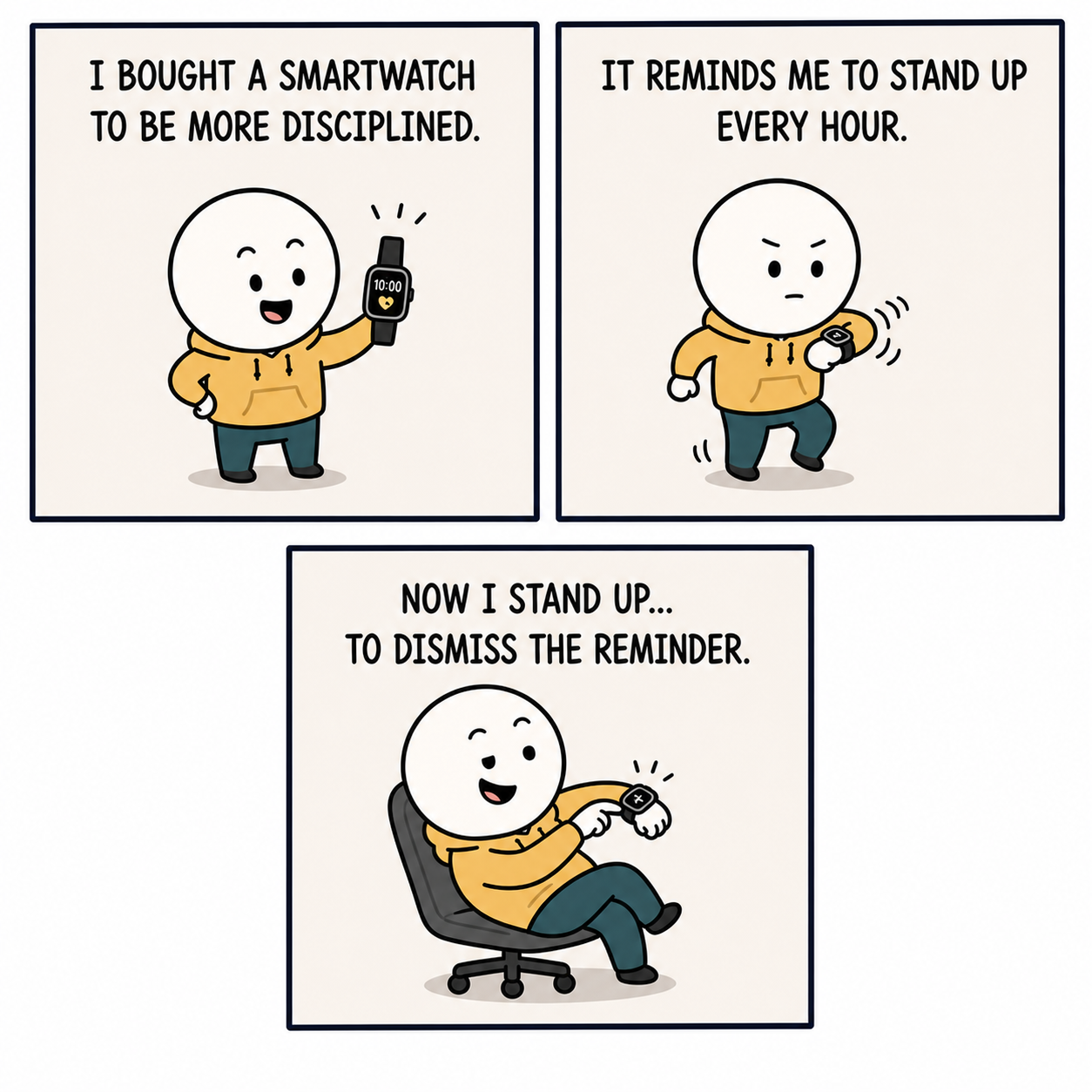
I bought a smartwatch with one simple belief: if technology reminded me often enough, I would become more disciplined.
It counted my steps, measured my heart rate, tracked my sleep, and vibrated whenever I had been sitting for too long. It was a personal trainer wrapped around my wrist—one that never complained, never took a day off, and always knew exactly how long I had been inactive.
For the first few days, everything went according to plan.
The watch vibrated. I stood up.
It reminded me to drink water. I went to get a glass.
It told me I had reached my goal. I watched the activity ring close and felt as if I had briefly won at life.
Then adaptation kicked in.
When Reminders Become Background Noise
A few days later, the watch was still working just as hard. I was the one who had changed.
It buzzed while I was working. I tapped “dismiss.”
It told me to stand. I raised my wrist, cleared the notification, and remained exactly where I was.
Eventually, the gesture became automatic. I no longer needed to read the message. One quick tap made the reminder disappear, allowing me to return to work—or, more accurately, to whatever excuse was keeping me in my chair.
The irony was hard to miss. I had bought a device to build a habit of moving, but the first habit it helped me master was dismissing reminders quickly.
Technology Cannot Stand Up for Me
A reminder creates a moment of choice. It cannot make the choice for us.
The watch may know that I have been sitting for an hour, but it does not know whether I am postponing movement because I am tired, busy, or simply too comfortable. It can vibrate on my wrist, but it cannot make my legs move.
At first, I thought the reminder was not strong enough. Maybe it needed to vibrate longer, appear more frequently, or come from a stricter app.
But the more notifications I added, the better I became at ignoring them.
The problem was not the intensity of the reminder. The problem was that the requested action was still too easy to refuse.
Replace “Exercise” with One Small Action
“Stand up and move” sounds simple, but it is still vague enough for the brain to negotiate:
- How long do I need to stand?
- What should I do once I am up?
- Can I do it later?
- Does this really matter right now?
So I changed the rule. Whenever the watch vibrated, I no longer forced myself to exercise. I only had to do one specific thing: stand up, get some water, or take 20 steps around the room.
No workout clothes. No training video. No impressive target.
The goal was no longer to “become a disciplined person.” The goal was simply not to dismiss the reminder while my body was still in the chair.
A tiny action may not sound meaningful, but it removes the hardest part: getting started.
Design the Environment, Not Just the Notification
I also realized that the watch was only the final layer of the system. My environment determined whether an action was easy enough to happen.
I placed my water bottle away from my desk so I had to stand up to reach it. I kept some open space beside the desk so I could stretch immediately. During calls that did not require a screen, I wore headphones and walked around the room.
None of these changes were smart. They did not sync data or produce beautiful charts. They simply made the better choice more convenient.
Once the environment supported the behavior, the watch reminder stopped feeling like an annoying command. It became a signal to begin an action that had already been made easy.
Measure What Matters, Not Only What Is Easy to Count
A smartwatch is excellent at counting steps, active minutes, and estimated calories. Those numbers, however, never tell the whole story.
Missing a step goal does not automatically make a day a failure. Closing every activity ring does not necessarily mean that life is balanced.
Now I try to pay attention to simpler questions:
- Did I respond when my body needed a break?
- Did I deliberately step away from the screen?
- Did I still have energy for my life after work?
Technology is most useful when it helps us notice ourselves—not when it turns every day into a scoreboard.
The Watch Did Not Make Me More Disciplined
At least, not in the way I expected.
It did not transform me into a perfect person who always completed every target. It simply kept asking a small question: do you want to take care of your body right now?
Some days, my answer is yes. On other days, I still tap dismiss.
But I no longer confuse owning a tool with changing a habit. The watch can remind me. A system can support me. In the end, I am still the one who has to stand up.
And sometimes, 20 steps around the room are a good enough beginning.