I Organized Every Task—and Somehow Did None of Them
I Organized Every Task—and Somehow Did None of Them
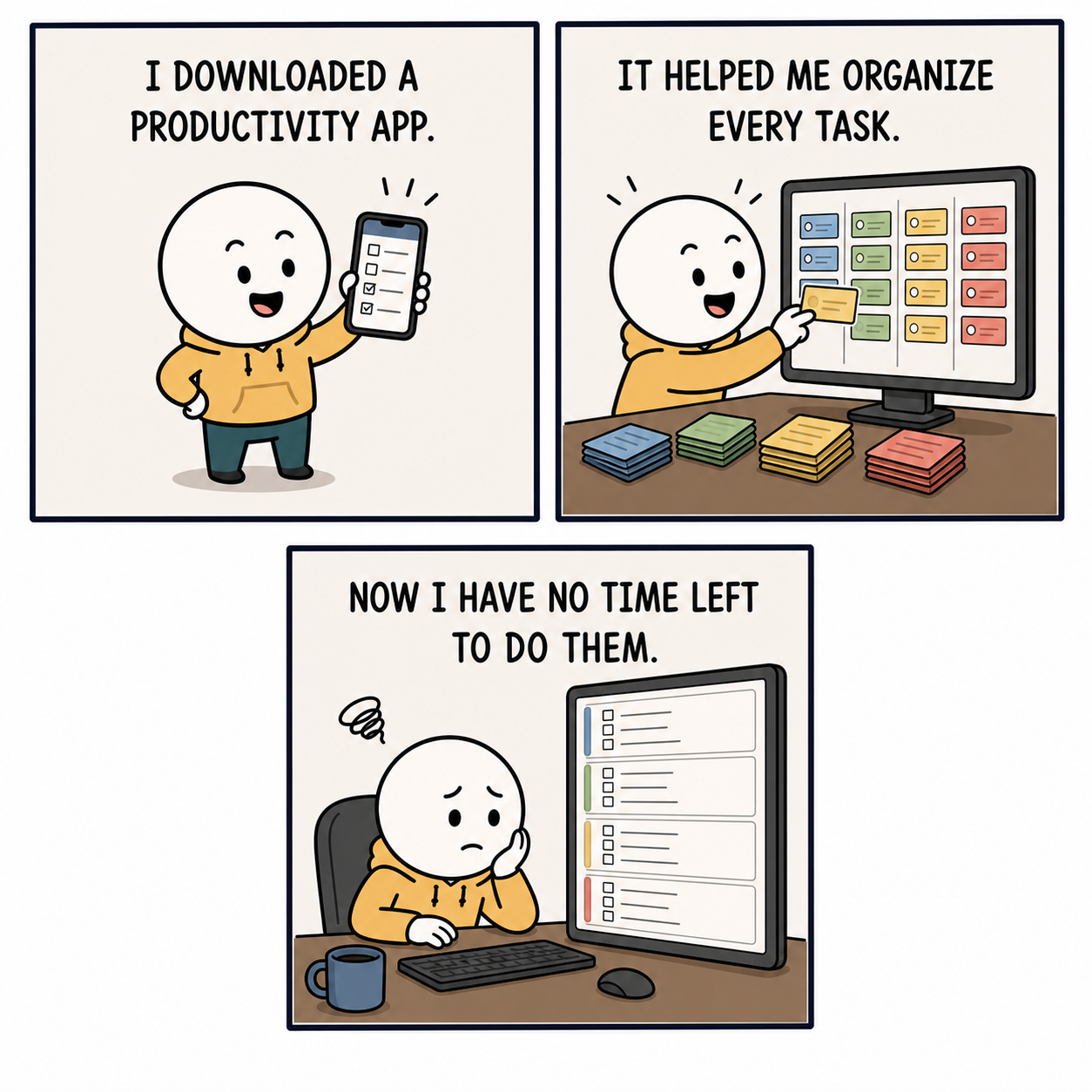
I downloaded a productivity app because my work felt scattered. Tasks lived in notebooks, browser tabs, chat messages, and the unreliable part of my brain that always says, “I’ll remember that.”
The new app promised order. I created projects, labels, priorities, colors, due dates, recurring rules, and a folder called “Someday” that immediately became home to everything I did not want to think about.
By lunchtime, every task had a place.
By the end of the day, none of them had been done.
Organizing Feels Suspiciously Like Progress
The dangerous thing about organizing is that it produces visible results. A messy list becomes clean. Red badges disappear. Tasks line up beneath tidy headings. The system looks better, so it feels as if the work itself has improved.
But the client did not need a beautifully tagged task. They needed the task completed.
I had confused improving the map with traveling the road.
Planning Can Be a Comfortable Form of Avoidance
Real work contains uncertainty. Writing may be bad. Code may fail. A difficult conversation may be awkward. Organizing tasks avoids all of that while letting us remain close enough to the work to feel responsible.
That is why planning can be so seductive. It gives us control without requiring exposure.
Whenever I felt resistance toward a task, I found another property to edit. Was it really “high priority,” or merely “important”? Should it live under Work, Personal, or a new category called Strategic?
These questions sounded useful. Mostly, they delayed the moment when I had to begin.
A System Should Reduce Decisions
My productivity setup became useful only after I made it smaller.
I kept three views:
- Today: no more than three meaningful tasks.
- Next: work that is ready but not urgent.
- Waiting: anything blocked by another person or event.
No complex scoring. No perfect taxonomy. If a task took less than two minutes to organize, fine. If organizing it took longer than starting it, I had to start.
The system stopped being a hobby and returned to being a tool.
Start Before You Optimize
Now, when I feel the urge to redesign my workflow, I do ten minutes of the actual task first.
Ten minutes is small enough to avoid negotiation, but large enough to reveal what the work really needs. Sometimes the task becomes easy once it is moving. Sometimes I discover a genuine blocker worth adding to the system.
Either way, reality gives better information than another hour of organizing.
The Best Task Is the One That Leaves the List
A productivity app cannot decide what deserves my attention. It can only store the decisions I make.
A neat list may lower anxiety, and that matters. But the purpose of a list is not to become perfect. Its purpose is to help something leave the list.
These days, my task manager is less impressive. It has fewer labels, fewer colors, and several tasks written in embarrassingly plain language.
It also contains more completed work.
That feels like a better feature.