When Planning the Day Becomes the Day
When Planning the Day Becomes the Day
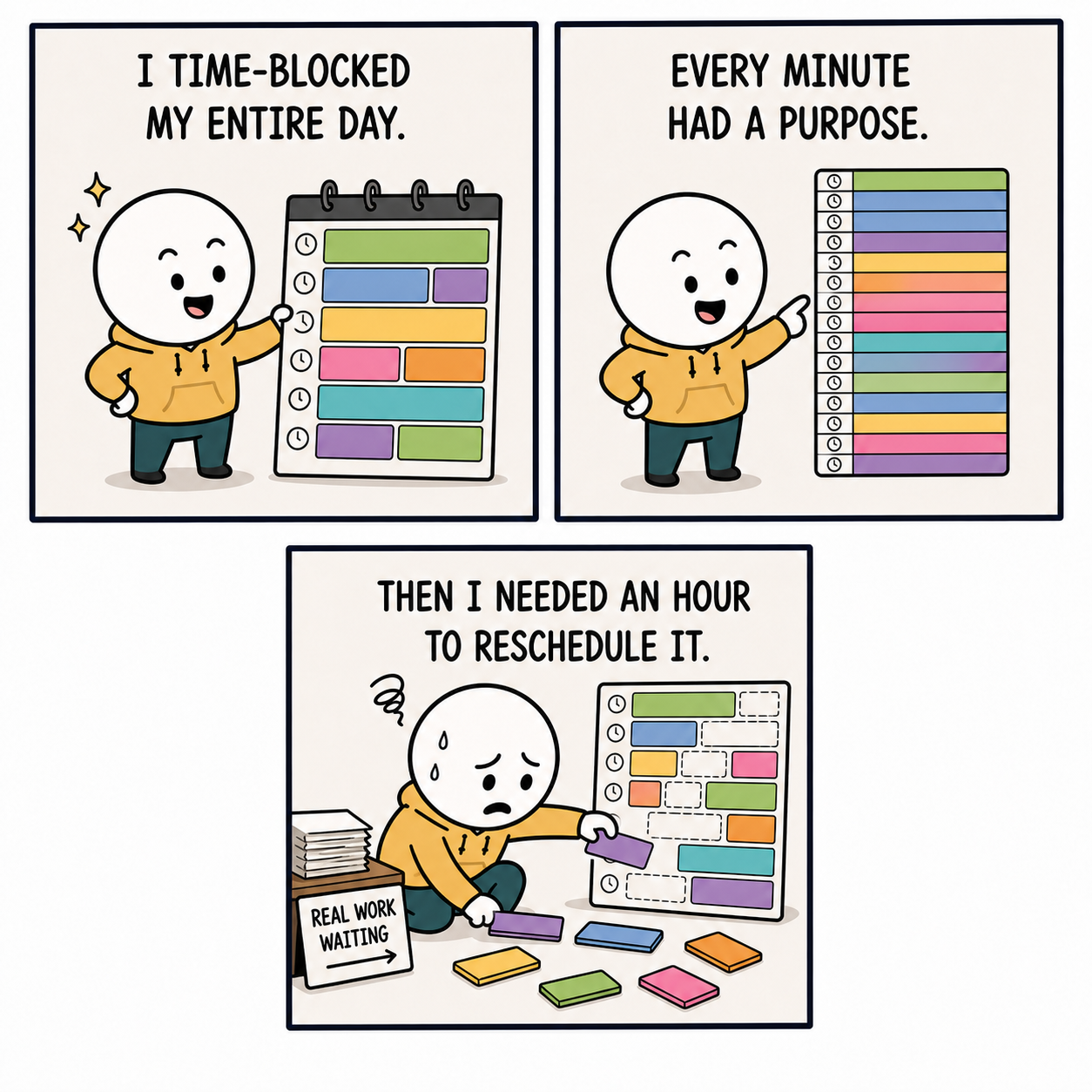
I time-blocked my entire day because I wanted to be intentional.
Deep work was blue. Meetings were orange. Exercise was green. Lunch had its own calm yellow rectangle. Even the gaps between tasks looked productive.
For a few minutes, my future appeared beautifully under control.
Then one meeting ran late, an email became urgent, and a task took twice as long as expected. I responded by moving blocks around until the calendar looked believable again.
By the time the schedule was repaired, I had lost another hour.
A Perfect Calendar Is a Fragile Calendar
Time-blocking is useful because it turns vague intentions into appointments. But my first schedules left no room for being human.
Every minute had a purpose, which meant every surprise became a failure.
A plan with no empty space assumes perfect estimates, constant energy, and a world that never interrupts. That is not a plan. It is optimistic fiction displayed in calendar form.
Rescheduling Has a Cost
Moving a block takes seconds. Rebuilding the mental model of the day takes longer.
Each adjustment asks new questions: What moves next? What becomes late? Which promise matters most? Can the workout fit after dinner? Should tomorrow absorb the unfinished work?
When I repeated this process all day, planning became a second job layered on top of the first.
The calendar was supposed to reduce decisions. Instead, it kept generating them.
Plan Anchors, Not Every Minute
My schedule became calmer when I separated fixed anchors from flexible work.
Anchors include meetings, appointments, meals, and genuine deadlines. Around them, I reserve broader blocks such as “focused work” or “administration” without assigning every minute to a specific task.
Inside a block, I choose from a short priority list based on time and energy.
This keeps direction without pretending I can predict the day perfectly.
White Space Is Part of the System
I now leave buffers between demanding blocks and keep part of the afternoon unassigned.
At first, empty calendar space looked wasteful. In practice, it absorbs the delay that would otherwise knock over the rest of the day.
If nothing goes wrong, the buffer becomes rest, a walk, or extra progress. If something does go wrong, the schedule bends instead of breaking.
White space is not the absence of planning. It is planning for reality.
The Calendar Is a Draft
The biggest change was treating the schedule as a suggestion made by my past self, not a contract enforced against my present self.
Plans should guide attention. They should not require constant maintenance to protect the illusion that everything is under control.
I still time-block important work. The colors are satisfying, and seeing a real commitment on the calendar helps me defend it.
But when the day changes, I no longer rebuild every rectangle. I choose the next important thing, adjust only what truly matters, and let some blocks remain imperfect.
A useful calendar helps me live the day.
It does not become the day.